UCB EECS MEng
Program Overview
Berkeley EECS is a top 4 CS school. The program's goal is clear: help students find a job in the shortest time possible.
Course-wise, MEng is not a research-oriented master's like MSR, but rather application-focused. Besides technical courses, Leadership courses are required, and the Capstone project spans the entire academic year. Since MEng is only one year, the window for job searching is extremely tight, so most people start LeetCode grinding and submitting resumes from day one.
In previous years, some students may have been able to extend by persistently requesting extensions, but at least starting from 24 Fall, extension for CPT to do internships and convert to full-time is no longer allowed. According to data from current students, the full-time landing rate as of February 2025 is approximately 30%. Even if you try hard to get an extension, CPT will not be approved.
When applying, you need to select a track. CS students typically choose the DSS track (the DSS track was split into Data Science and Computer Systems tracks starting 24 Fall). Graduation requires completing a Capstone project, similar to the UW EE PMP Capstone project. However, you need to write an essay explaining your interest in the project and may even need to interview -- somewhat like the application process. Current students report that the quality of these Capstone projects is uneven, with a 90% chance you won't produce anything meaningful.
UCB has a relatively high number of homeless people nearby, so you need to be mindful of safety. However, the EECS engineering buildings are located in the more remote northern part of campus, which is scenic and not a concern regarding homeless people. Rent is relatively low, and factoring in scholarships, the total cost comes to around $40K.
Although CPT is not approved, the school is very supportive of students, frequently organizing various events including alumni networking and interview coaching. Alumni are also willing to help. The Berkeley name is still a gold standard (after all, it's CS top 4).
Ideal Applicant Profiles
- US undergrads going from senior year to master's, already interned at a major company with a return offer.
- Mainland China undergrads with at least 9 months of internship experience.
- Post-undergrad with at least 1 year of full-time work experience.
- Willing to pay the tuition and hoping to take a chance at landing a job directly through the program.
Admission Preferences & Representative Data Points
GPA carries significant weight in admissions. Scholarship allocation is essentially based on GPA: 3.9+ generally gets $10K, 3.93+ gets $15K, 3.95+ gets $20K. Internship and research experience also matter, but GPA is still the most important factor.
Regarding GRE, it was optional during the pandemic, so not taking it was fine. For TOEFL, US undergrads can get a waiver, and mainland China undergrads just need to meet the minimum threshold -- it's not a critical evaluation factor.
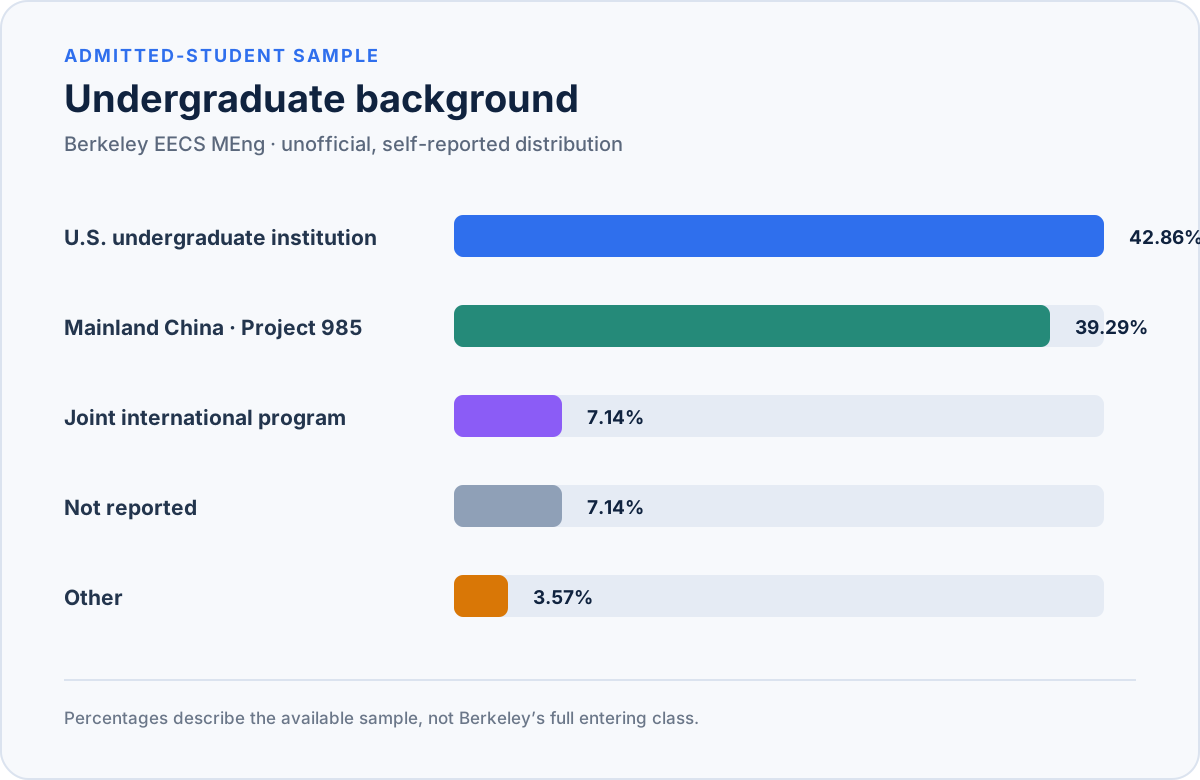
The program prefers high-GPA and US undergrad students. Mainland China students are mostly from 985 universities. US undergrads and mainland China 985 students each make up about 40%. Over 70% of students have a GPA above 3.8. According to unofficial statistics, the program particularly favors students with Berkeley exchange experience.
- ZJU Digital Media Design, had Harvard RA, GPA 3.95
- UofT, GPA 3.88, four co-op internship experiences
- UIUC EE undergrad, multiple small company internships
- UofT CS undergrad, GPA 3.94
- NTU/NTHU CS, major GPA 4.05/4.3, two publications, 9 months full-time backend experience
Course Structure
MEng courses are divided into three parts: Technical courses, Leadership courses, and the Capstone project.
The selection range for Technical courses is much smaller than a regular MS. Each track has a fixed course list. While most courses are reasonably challenging, the limited selection freedom frustrates many students. For example, if you chose the wrong track when applying, you're stuck taking courses you're not interested in, or you have to apply to take courses from other tracks -- but getting in depends on luck. Overall, course quality is guaranteed. Hot courses like CS189 (Machine Learning) and CS285 (Deep Reinforcement Learning) have excellent professors with substantial assignments, and you'll definitely learn a lot if you take them seriously.
Leadership courses are quite controversial. While the name sounds impressive, many people find them superficial, or at least not worth the time and effort. You have to write 300-500 words per week, read many case studies, actively participate in class discussions, and there's even a cold call mechanism where you can be randomly called on to answer questions.
The Capstone project is a two-semester long-term project. Some are in collaboration with companies, others are purely academic research. If you get a responsible advisor and the project aligns with your interests, you can learn a lot. But if the advisor is hands-off or the project direction doesn't match your goals, you might just do the minimum to get by. For those wanting to apply to PhD programs, the Capstone isn't deep enough.
Job Outcomes
Overall, job search outcomes are decent -- noticeably better than Yale MSCS, which is also a one-year program.
-
ZJU Digital Media Design, no internships, landed Meta new grad
-
UIUC EE undergrad, had small company internship, landed RTX
-
UBC EE undergrad, multiple small company internship experiences, landed small company new grad
-
UofT EE undergrad, had Amazon and Huawei internships (Canada-based), landed NVIDIA
-
NTU/NTHU CS undergrad, 9 months full-time backend experience, landed Google
-
Purdue EE undergraduate, MEng completed in 2023; SWE intern at a small company, SLB EE full-time in 2023, Apple Lab Operations Engineer full-time in 2026.
Living Experience
Close to the Bay Area with pleasant weather and plenty of good restaurants nearby. Especially with a car, weekend trips to SF for dinner or ocean views make for a high quality of life.
The campus facilities are average. The EECS building is fairly old, and library seating fills up fast, making it sometimes hard to find a quiet study space. Berkeley's athletic facilities are good -- students get free access to swimming pools, gyms, and other resources. If you enjoy outdoor activities, there are many hiking trails near campus, making running or hiking very convenient.